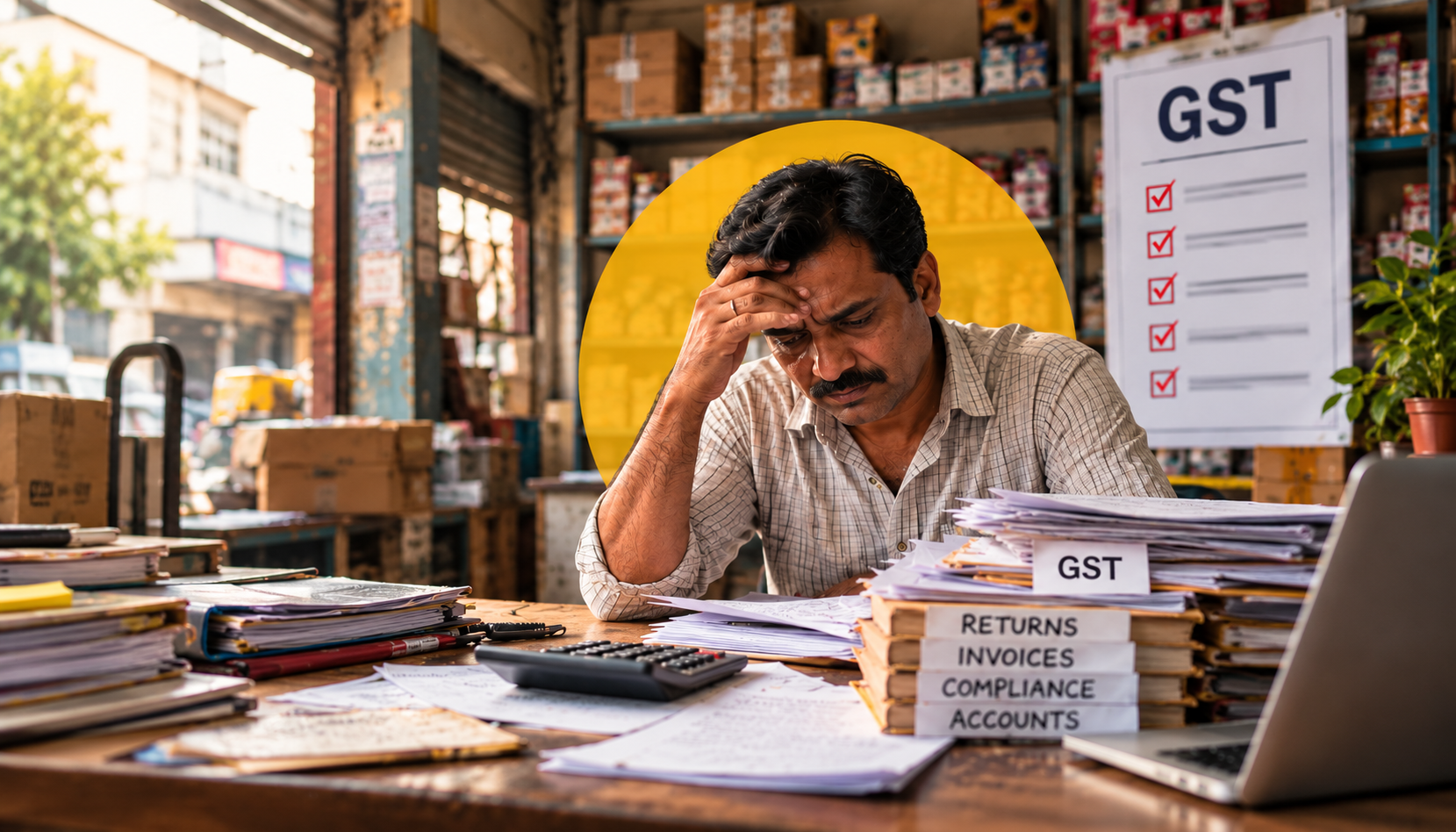
India’s smallest unincorporated businesses are facing a disproportionately high cost of complying with the Goods and Services Tax (GST) regime, according to a recent study based on government survey data.
The analysis, based on the National Sample Survey Office’s Annual Survey of Unincorporated Sector Enterprises (ASUSE) 2022-23, estimates that GST-related compliance costs can account for between 3.28% and 13.90% of annual turnover for these businesses. When measured against average annual operating expenses, the burden ranges from 4.64% to 19.71%.
The findings come at an important time, with the GST Council scheduled to discuss further process reforms aimed at making tax compliance simpler for businesses.
Smaller Businesses Face a Bigger Relative Burden
Unincorporated enterprises typically include small, owner-operated businesses functioning as proprietorships or partnerships rather than incorporated companies.
While their absolute compliance expenses may be smaller than those of large companies, the study highlights a different issue: the cost can represent a much larger share of their business income and operating expenses.
Businesses with annual turnover below ₹4.9 lakh are estimated to face a higher relative compliance burden than enterprises with turnover of ₹4.9 lakh or more.
This creates a particular challenge for very small businesses, where even modest accounting, filing and administrative expenses can affect profitability.
Why GST Compliance Can Be Expensive
GST was introduced with the broader objective of creating a more unified indirect tax system and simplifying the tax structure.
However, registered businesses have to manage several ongoing requirements.
These include:
- Periodic GST return filing
- Input tax credit reconciliation
- Digital record keeping
- E-way bill compliance
- E-invoicing requirements for applicable businesses
- Maintaining supporting documentation
- Responding to tax-related notices and queries
For larger businesses with dedicated finance and tax teams, these processes can be integrated into regular operations.
For a small proprietor or partnership, the same requirements may involve external accountants, additional software and significant time spent on compliance.
Only a Small Share of Surveyed Enterprises Were GST/VAT Registered
The study also highlights the relatively low level of indirect-tax registration among the enterprises covered by the survey.
According to the ASUSE data cited in the report, only 2.41% of enterprises in the sample were registered under GST or VAT.
GST registration can provide businesses with access to formal supply chains and allow eligible enterprises to claim input tax credit.
However, the researchers noted that the available data indicates substantial reluctance among small enterprises to enter the indirect-tax system.
For businesses operating at very small scales, the perceived benefits of formalisation may not always outweigh the time and financial resources required to comply.
Compliance Costs Can Influence Formalisation
The study’s findings are significant beyond taxation.
For policymakers, one of the larger questions is how to encourage small businesses to move into the formal economy without making the compliance process disproportionately expensive.
High compliance costs can potentially discourage smaller enterprises from registering, particularly when the cost of maintaining compliance represents a significant share of their revenue.
The researchers, Sacchidananda Mukherjee and Shivani Badola of the National Institute of Public Finance and Policy (NIPFP), said the findings highlight the challenges faced by unincorporated enterprises under the GST system.
GST Council Set to Discuss Process Reforms
The findings come ahead of the next meeting of the GST Council on October 7, where process-related reforms are expected to be discussed.
Among the areas under consideration are measures to make GST registration and return filing faster and simpler.
Issues surrounding blocked input tax credit and refunds are also expected to be part of the discussions.
Recent reports indicate that the Council may also consider measures such as simplifying registration procedures, reducing certain penalties and easing compliance requirements for smaller taxpayers.
The Larger MSME Challenge
The GST compliance issue sits within a broader challenge faced by India’s micro and small businesses.
The unincorporated sector remains a major part of India’s employment and entrepreneurial landscape. Government data released in August 2026 estimated that the sector had 8.67 crore establishments and 13.70 crore workers during April-June 2026. The same data showed a year-on-year increase of 9.2% in the number of establishments.
At the same time, formalisation is increasing. Government data showed that enterprise registration reached 42.5% during April-June 2026, up by more than seven percentage points from the corresponding period a year earlier.
This makes the question of compliance design increasingly important: as more small businesses enter formal systems, the cost and complexity of maintaining compliance become more consequential.
What Could Make GST Easier for Small Businesses?
The study points to a broader policy challenge: simplification needs to account for the size and capabilities of the taxpayer.
A small proprietor may not have the same financial resources, accounting staff or technology infrastructure as a large corporation.
Potential improvements in the wider compliance ecosystem could therefore focus on:
- Simpler return-filing processes
- More automated reconciliation
- Easier registration and amendments
- Faster refunds
- Clearer compliance requirements
- Greater use of technology for routine filings
- Lower administrative costs for very small businesses
Such measures could potentially make formalisation more attractive while allowing small businesses to spend more time on operations and growth.
The Road Ahead
GST has significantly changed India’s indirect-tax landscape, but the experience of the smallest enterprises shows that tax simplification is not only about the number of tax rates—it is also about how easy the system is to operate.
For large companies, compliance can be handled through specialised teams and technology. For a small business owner, the same process can represent a meaningful financial and operational burden.
As the GST Council considers further process reforms, the study provides a data-backed reminder that the success of India’s formalisation push will depend not only on bringing more businesses into the tax system but also on ensuring that compliance remains practical and proportionate for the smallest enterprises.