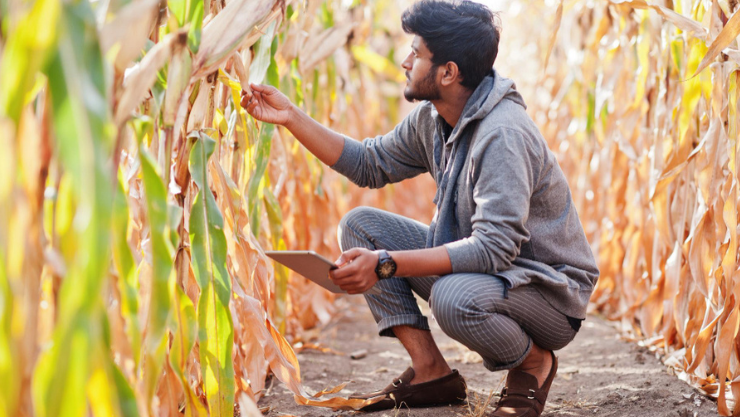

Fasal, an innovative Bengaluru-based agritech startup founded in 2018 by Ananda Verma and Shailendra Tiwari, is transforming India’s horticulture landscape through data-driven precision agriculture. With its deep integration of Internet of Things (IoT), artificial intelligence (AI), and crop science, the company is creating a technology-led farming ecosystem that optimizes resource use, enhances yields, and improves farmers’ profitability. At a time when Indian agriculture faces rising challenges from climate change, resource scarcity, and fragmented landholdings, Fasal’s approach is both timely and transformative.
The startup’s core offering revolves around a full-stack precision horticulture platform that collects real-time data from on-farm sensors. These sensors monitor crucial parameters such as soil moisture, temperature, humidity, and crop growth patterns. This continuous stream of data feeds into predictive analytics models that deliver actionable insights to farmers. Whether it is determining the optimal irrigation schedule, identifying early signs of pest and disease outbreaks, or fine-tuning fertilizer use, Fasal provides farm-specific guidance designed to reduce waste and maximize productivity. The platform also supports multiple vernacular languages, ensuring that its technology remains accessible to farmers across diverse regions.
Beyond offering agronomic intelligence, Fasal has built a vertically integrated ecosystem connecting farm to market through its initiative, Fasal Fresh. This business-to-business channel enables farmers to sell high-quality, traceable produce directly to buyers. By linking digital advisory with market access, Fasal empowers farmers not only to grow better crops but also to secure better prices. This model reflects the startup’s larger vision of building a transparent, sustainable, and technology-driven agri-value chain.
Fasal’s impact is already visible across India’s horticultural regions. The company reports operations spanning over 75,000 acres, covering high-value crops such as grapes, pomegranates, bananas, apples, chillies, and cardamom. Farmers using its solutions have seen measurable improvements in resource efficiency, with significant reductions in irrigation water use, pesticide applications, and energy consumption. Many have also experienced yield increases of up to 30 percent and improved crop quality, which translates into higher earnings and stronger market competitiveness. These outcomes underline how technology, when adapted to local conditions, can redefine farming efficiency in developing economies.
In December 2023, Fasal secured approximately ₹100 crore in Series A funding led by TDK Ventures and British International Investment, with participation from 3one4 Capital, Omnivore, and Wavemaker Partners. The infusion of capital is being directed toward scaling the company’s operations from 75,000 acres to a targeted 500,000 acres, strengthening its R&D capabilities, and advancing sustainability goals. The company has expressed its intention to build carbon-negative value chains and expand its presence beyond India, particularly in Southeast Asia, where horticulture faces similar climatic and productivity challenges.
Fasal’s mission goes beyond simply deploying technology. It is reimagining how modern agriculture can function as a data-driven, sustainable enterprise. The founders’ vision is rooted in the idea of “grow more with less,” a principle that aligns with India’s broader goals of achieving food security while conserving natural resources. By digitizing the cultivation process and introducing farmers to precision methods, Fasal enables them to make informed decisions, replacing guesswork with scientific precision. This not only improves yields but also promotes long-term soil health and environmental resilience.
However, scaling such a model across India’s fragmented agricultural landscape presents challenges. Deploying IoT hardware across thousands of small farms requires logistical precision, capital investment, and sustained farmer engagement. Training farmers to interpret and trust data insights remains a continuous effort. Moreover, integrating market access with production intelligence requires coordination across multiple stakeholders, including distributors, buyers, and logistics partners. Fasal’s ability to maintain cost efficiency while expanding its sensor network and ensuring consistent data quality will be critical to its growth trajectory.
What distinguishes Fasal in the agritech space is its end-to-end approach. Many startups in India have focused either on digital advisories or on marketplace solutions. Fasal, however, bridges both, creating a unified ecosystem that supports farmers throughout their production and sales journey. This integration strengthens its position in an increasingly competitive agritech market, where investors and policymakers are emphasizing measurable impact and scalability.
As India advances toward sustainable agriculture, Fasal’s model presents a blueprint for combining technology, environmental responsibility, and economic empowerment. The startup’s data-centric strategy aligns closely with global trends in precision farming, where IoT and AI are revolutionizing crop management practices. Yet, Fasal’s localization of these technologies for Indian conditions—addressing smallholder challenges and regional crop diversity—sets it apart as a distinctly homegrown innovation.
Looking ahead, Fasal aims to deepen its technological infrastructure, expand its data analytics capabilities, and explore partnerships that enable ecosystem-wide impact. There are possibilities for integrating financial and insurance services, carbon credit initiatives, and export-focused market linkages within its ecosystem. Such diversification could strengthen its sustainability footprint and help Indian farmers integrate more effectively into global supply chains.
Fasal exemplifies how innovation, purpose, and technology can converge to create meaningful change in India’s agricultural sector. Its journey reflects the growing confidence of Indian startups to tackle complex problems with scalable, science-driven solutions. In doing so, Fasal is not just improving farm productivity—it is redefining the future of sustainable farming in India.